
The Institute of Sociology of the Czech Academy of Sciences warmly invites you to attend two keynote lectures organized as part of the workshop Living with Inflammation: Inquiry into the Ontology and Politics of Flammability, taking place on 9–10 April 2026 at the Academic Conference Center (Husova 4, Prague 1).
While the workshop itself is closed, everyone is warmly welcome to attend the keynote lectures.
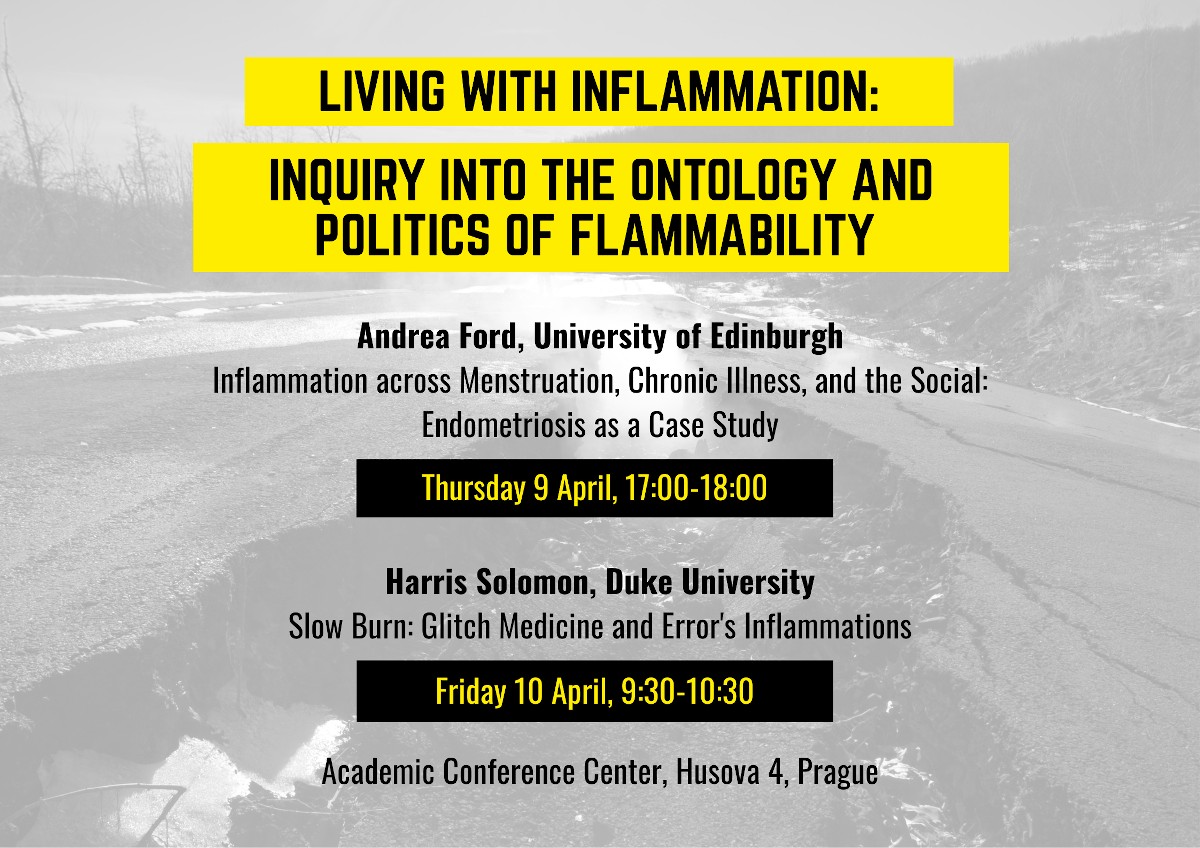
Inflammation across Menstruation, Chronic Illness, and the Social: Endometriosis as a Case Study
Andrea Ford, University of Edinburgh
Thursday 9 April, 17-18
Abstract:
This talk builds on the specific case of endometriosis to consider how "inflammation" is rising to prominence as a dominant trope and analytic of medical and popular culture. Although periods are conventionally attributed to hormones, specialist researchers are framing them as inflammatory events and linking problematic menstrual "symptoms" such as pain, swelling, and heavy bleeding to dysregulated inflammation. Inflammation is itself a hormonally driven process, and bridges are increasingly being built in popular and medical realms between "stress hormones” correlated with inflammation and the "sex hormones” held responsible for menstrual cycles. Chronic, non-communicable conditions are also being attributed to inflammation, raising questions about why these are more common in women. Endometriosis is a condition that straddles this divide, as it is associated with menstruation and conventionally treated as gynecological, yet is now understood to be a chronic, systemic, inflammatory condition that extends far beyond menstruation. Across specialized research and popular media, it is common to encounter the idea of moderating symptoms through anti-inflammatory diets or lifestyle modifications to align one's “stress” with one’s cycle. These activities, whether construed as management, coping, or optimization, negotiate lived experience through metaphors of an inflamed gendered body existing within an inflammatory society. Drawing from ethnographic and interdisciplinary projects on endometriosis in the UK, the talk explores how society is understood to “get under the skin” (in Landecker's formulation) and how bodily systems are rendered indiscrete. It concludes by reading the concept of inflammation in light of classic critical and humanistic analyses of immunity, such as those by Emily Martin, Eula Biss, Ed Cohen, and Nik Brown. Inflammation is understood to be an effect of the immune system, but immunity — that is, managing boundaries and separations — is quite different from how inflammation is figured. Chronic inflammation can seem like a breakdown of immunity, or the product of a maladaptive immune system — begging the question of how to reconceptualize bodily boundaries.
Slow Burn: Glitch Medicine and Error's Inflammations
Harris Solomon, Duke University
Friday 10 April, 9:30-10:30
Abstract:
How might we understand medicine's contemporary forms of smoldering - the slow burn of medicine doing its work? This talk conceptualizes error as the inflammation of medicine itself, by examining the fraught connections between error, harm, and medicine in India. It draws on ethnographic fieldwork about medical errors and healthcare cyberattacks as they subtend uneven processes of hospital privatization and public health digitization. Healthcare workers must increasingly navigate the specters and the actualities of iatrogenesis, or the harm that medicine may cause. At stake, I argue, is what I call "glitch medicine": a transformation in the very nature and function of medicine characterized by intensified proximities to danger and quests for safety.
Vědci / vědkyně
doc. Mgr. Tereza Stöckelová, Ph.D.
Oddělení: Národní kontaktní centrum - gender a věda
V rámci projektu
Za hranice bezpečnosti: role konfliktu v posilování odolnosti (CoRe)
Trvání projektu: 2023 - 2028
Připojené soubory
- inflammable-keynotes.png (png, 1.74 MB)