Select your language

857 Publications

Adolescent fear of crime: Testing Ferraro’s risk interpretation model

Adolescent fear of crime: Testing Ferraro’s risk interpretation model

The aim of this study is to broaden the scope of knowledge on fear of crime by examining if Ferraro’s risk interpretation model of fear of crime also holds true for the adolescent population. Using data on approximately 1500 Czech students in middle and grammar school, we test three different models. First, the classic model of fear of crime, applied originally to adults, is estimated. Second, the role of perceived school disorganization is examined, taking into account that adolescents spend a substantial p…

Topics: Criminality

Publication Type: Article with impact factor

Department: Values and Politics

Read more …

“This Country is not for Anyone”. Explanations of Low National Pride in the Czech Republic.

“This Country is not for Anyone”. Explanations of Low National Pride in the Czech Republic.

National pride is a group-based and sometimes collective emotion people feel towards their nation-state. It is often measured by the general national pride item in cross-national surveys, and Czechs belong to those nations that express low levels of general national pride in comparison with other nations. It is currently under discussion how much general national pride is influenced by social desirability and how much by specific reasons. The goal of this article is to show specific reasons influencing general…

Topics: Identity

Publication Type: Article with impact factor

Department: Values and Politics

Read more …

Beaty still matters: The role of attractiveness in labour market outcomes

Beaty still matters: The role of attractiveness in labour market outcomes

The main objective of the study is threefold: first, to examine the role of attractiveness in the Czech labour market second, to assess gender differences in returns of attractiveness and third, to show that the positive association between attractiveness and earnings does not disappear even when cognitive skills, social background, occupational status and individual characteristics are controlled for. The study uses data from the first large-scale sociological survey focusing on attractiveness carried out in …

Topics: Economy, Gender, Wages and Incomes, Education

Publication Type: Article with impact factor

Department: Values and Politics

Read more …

Publication Type: Chapter in a Book / Monograph

Department: Values and Politics

Read more …

Where are Czech Voters Created?

Topics: Politics and Political Attitudes

Publication Type: Chapter in a Book / Monograph

Department: Values and Politics

Read more …

Are Czechs Really Nostalgic for Life under Communism?

Topics: Politics and Political Attitudes

Publication Type: Chapter in a Book / Monograph

Department: Values and Politics

Read more …

Czech Republic: Political development and data for 2017

Topics: Politics and Political Attitudes

Publication Type: Non-peer-reviewed article

Department: Values and Politics

Read more …

The Czech Republic

Topics: Politics and Political Attitudes

Publication Type: Non-peer-reviewed article

Department: Values and Politics

Read more …

Publication Type: Article with impact factor

Department: Values and Politics

Read more …

Publication Type: Article with impact factor

Department: Values and Politics

Read more …

Publication Type: Article with impact factor

Department: Values and Politics

Read more …

Publication Type: Published review

Department: Values and Politics

Read more …

Theories explaining corruption in post-communist countries

This article is looking at theoretical approaches to the study of corruption and tries to answer the question what could be the reason behind differences in the level of corruption between post-communist countries and established democracies in Europe on the theoretical level. First, this article discusses the problems of the definition of corrupt on. Next, this article presents the most important theories explaining corruption from the sociological point of view. This article will focus especially on norms (w…

Topics: Corruption

Publication Type: Peer-reviewed article

Department: Values and Politics

Read more …

Life satisfaction and happiness: discussing the impact of fear of crime and victimization

Life satisfaction and happiness: discussing the impact of fear of crime and victimization

Subjective well-being is usually studied with respect to marital and occupational status, income or subjective health. Conversely, research examining the relationship between this phenomenon and crime-related factors is still relatively limited. This study therefore aims to extend the current knowledge in this area. Using data from the fifth wave of the European Social Survey for the Czech Republic, in which 2386 respondents participated, we conduct a hierarchical regression analysis to find out to what extent…

Topics: Gender, Criminality

Publication Type: Peer-reviewed article

Department: Values and Politics

Read more …

Schicksalswende? Prozesse und Profile demokratischer Konsolidierung in Tschechien und der Slowakei

Kapitola srovnává přechod od autoritativního režimu v Československu k pluralitní demokracii ve dvou (později nezávislých) státech - České republice a Slovenské republice. Přitom je zvláštní pozornost věnována fungování demokracie v rámci konceptu ukotvené demokracie a je srovnáván vliv interních a externích faktorů. Autorky argumentují tím, že srovnání dvou zemí, které mají dlouhou společnou historii a prošly společně první fází demokratizace, aby se nakonec vyda…

Topics: Politics and Political Attitudes

Publication Type: Chapter in a Book / Monograph

Department: Values and Politics

Read more …

Does work make mothers happy?

The paper explores the link between employment and subjective well-being among mothers with small children. Using a pooled sample of the ESS 2004–2014 data from 30 European countries. Analyzing multiple measures of subjective well-being, the paper shows that homemakers are happier than full-time workers. There were no significant differences between homemakers and part-time workers. The variation across countries was not linked to the provision of formal childcare, of parental leave, or tax system.…

Topics: Work, Family

Publication Type: Article with impact factor

Department: Values and Politics

Read more …

The relationship between fear of crime and risk perception across Europe

The relationship between fear of crime and risk perception across Europe

Cross-national comparisons of fear of crime have been gaining in popularity within the academic community, as they allow for the examination of both individual and country-level correlates of this phenomenon. Nevertheless, the role of perceived victimization risk in fostering fear of crime with respect to various country specifics is often neglected. Drawing on data from the European Social Survey Round 5 (ESS R5), the aim of this study is to explore the relationship between fear of crime and risk perception i…

Topics: Criminality

Publication Type: Article with impact factor

Department: Values and Politics

Read more …

The impact of parenting style on fear of crime among adolescent girls and boys

The impact of parenting style on fear of crime among adolescent girls and boys

Research on adolescent fear of crime is still relatively limited and often simply applies theoretical explanations proposed for adults. This study strives to extend current knowledge in this field by analyzing the impact of parenting style on fear of crime, namely parental attachment, parental supervision, and parental support of adolescent autonomy, while also considering possible gender differences. Using data from a self-report survey of approximately 1500 Czech adolescents, a hierarchical regression analys…

Topics: Gender, Criminality

Publication Type: Article with impact factor

Department: Values and Politics

Read more …

Significant others and the importance of ancestry for Czech national identity

Significant others and the importance of ancestry for Czech national identity

Nations are viewed as metaphorical families having common ancestors. Czechs, for example, share the legend about a forefather Čech who brought his people into Czechia. Analysing the Czech ISSP 2013 data we examine how the importance of having Czech descent depends on Christian denomination, openness towards immigration, perceived commonality with ‘significant Others’, foreign-born parents, and socio-demographics. Results of the analysis suggest that Czech ancestry is less important part of national identi…

Topics: Identity

Publication Type: Peer-reviewed article

Department: Values and Politics

Read more …

Publication Type: Peer-reviewed article

Department: Values and Politics

Read more …

Why are pre-election polls wrong?

This chapter focuses on the pre-election polling in the Czech Republic. Specifically, it discusses the possible reasons why are pre-election polls wrong almost every elections. Chapter offers several explanations of this phenomenon, such as lying of respondents, reluctance to answer the survey questions, embargo, and others.…

Topics: Elections and Electoral Research

Publication Type: Chapter in a Book / Monograph

Department: Values and Politics

Read more …

Measuring corruption in Europe: Public opinion surveys and composite indices

Measuring corruption in Europe: Public opinion surveys and composite indices

This article offers a concise overview of composite indices and public opinion surveys measuring corruption perception and bribery on the European level and ascertains their quality and usefulness based on several criteria. Specifically, this article covers measures by the World Bank (Control of Corruption), Transparency International (Corruption Perception Index and Global Corruption Barometer), European Social Survey, International Social Survey Programme, World Values Survey, and Eurobarometer. Fi…

Topics: Corruption, Research Methodology
Publication Type: Article with impact factor

Department: Values and Politics

Read more …

Corruption in European Countries: A Cross-national Comparison

Corruption in European Countries: A Cross-national Comparison

This paper analyses the Control of corruption as measured by the World Bank and the possible causes for the level of corruption on a European level. Theories explaining the causes of corruption on a global level, namely GDP per capita, income inequality, generalized trust and the share of Protestants in the population are discussed and their validity is tested on a European level by pooling the data and conducting OLS regression analysis on the full sample of the European Social Survey data in the period …

Topics: Value Orientations, Corruption, Religion and religiosity

Publication Type: Chapter in a Book / Monograph

Department: Values and Politics

Read more …

Publication Type: Article with impact factor

Department: Values and Politics

Read more …

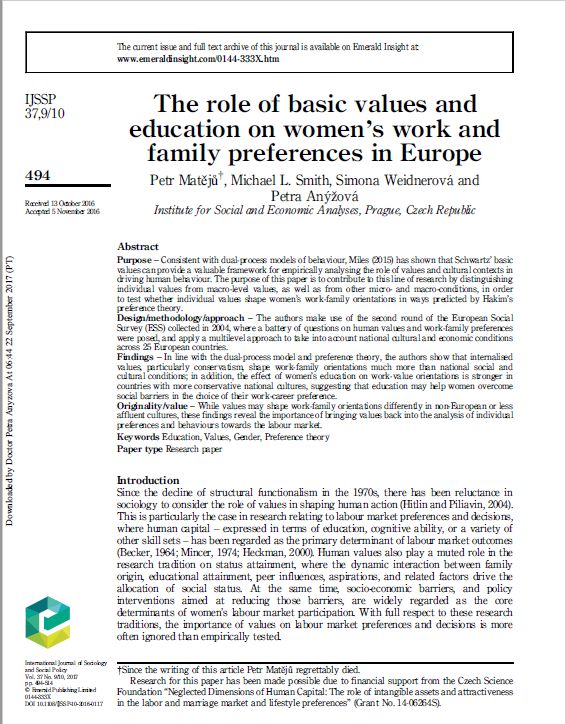
The role of basic values and education on women’s work and family preferences in Europe

The role of basic values and education on women’s work and family preferences in Europe

Purpose – Consistent with dual-process models of behaviour, Miles (2015) has shown that Schwartz’ basic values can provide a valuable framework for empirically analysing the role of values and cultural contexts in driving human behaviour. The purpose of this paper is to contribute to this line of research by distinguishing individual values from macro-level values, as well as from other micro- and macro-conditions, in order to test whether individual values shape women’s work-family orientations in ways …

Topics: Gender, Value Orientations, Education

Publication Type: Peer-reviewed article

Department: Values and Politics

Read more …

Newsletter

If you are interested in newsletter with news from the world of sociology, leave us your e-mail. We will keep you informed about our new publications and on events that we organize.

Bluesky

Nově nás naleznete také na Bluesky.